Why I stopped ignoring Prop 65 warnings on food
Kendra on how she reads a Prop 65 warning on food now, and why, with Canopy's heavy metals results for BetterBody Foods chia seeds and four seaweed snacks (Kirkland Signature, Trader Joe's, Bibigo, Gimme Teriyaki).
How I read the label now
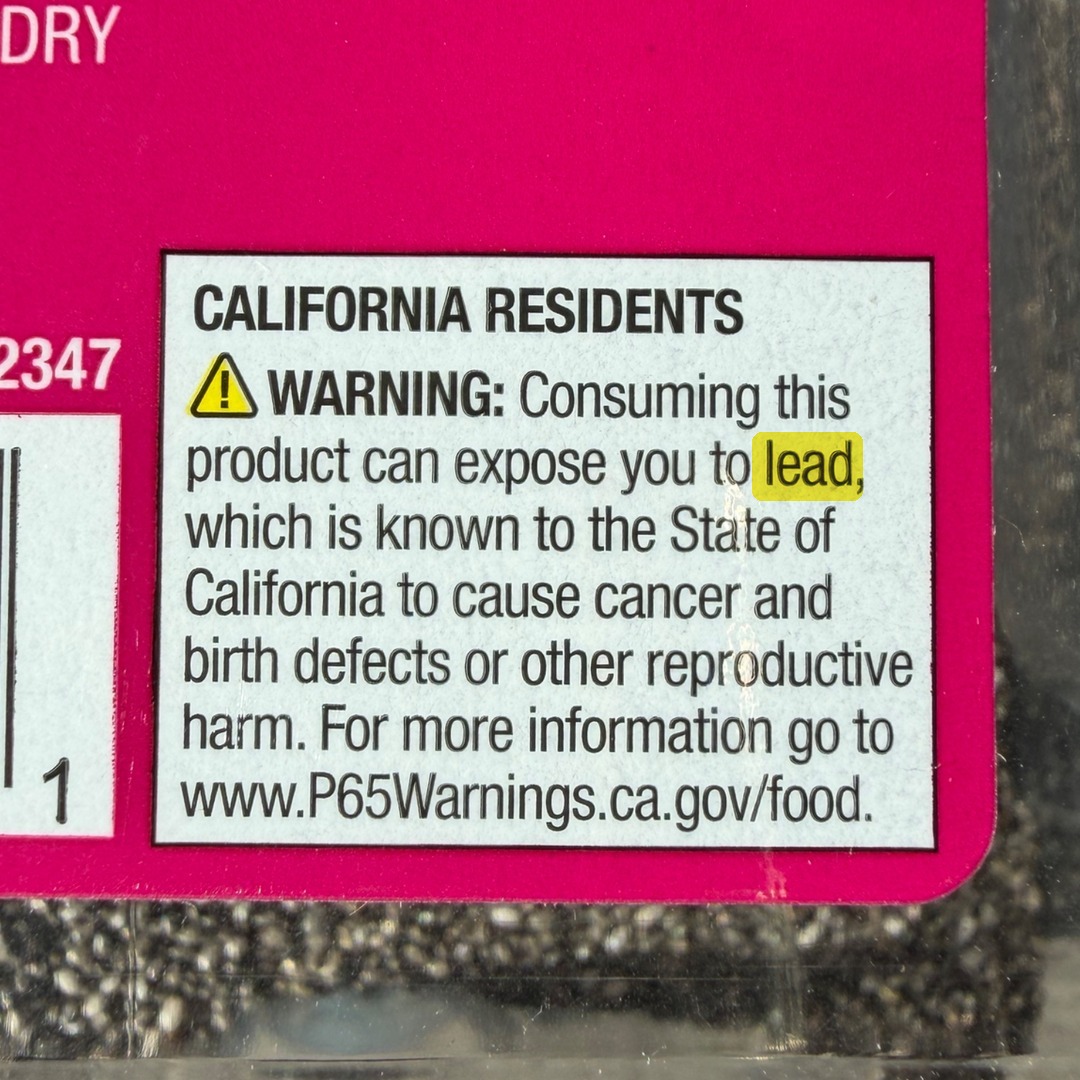
This post is about the Prop 65 warnings that show up on food for heavy metals: lead, cadmium, and arsenic. Those are the chemicals behind most food warnings, and ones Canopy tests for. Canopy tests branded food products for contaminants. People request a test on a product they buy, and once enough of them have chipped in, we buy it at retail and send it to a qualified laboratory.
Prop 65 is California's warning law for chemicals linked to cancer or reproductive harm. For each listed chemical it sets a safe harbor level, the daily dose below which no warning is needed. I'll call that the Prop 65 line. A warning means a serving may contain more than the line. The line is set for a 128 lb adult. For lead, cadmium, and arsenic it sits close enough to the daily limits health agencies recommend for a 50 lb child that one serving can be a significant share of a child's daily intake. So the question I ask in the aisle is how much of this heavy metal a child is actually eating.
First, has this product been tested? If it has, I compare the measured amount per serving to the health guidance for the smallest person eating it. If it hasn't, I estimate from the label:
Which metal. Today the label may or may not name the chemical. From January 1, 2028, it will have to (OEHHA, warning regulation amendments effective January 1, 2025). Until then, the food gives clues. In FDA's Total Diet Study, cadmium was highest in spinach, sunflower seeds, and potato chips, lead in sweet potato baby food, teething biscuits, and sandwich cookies, and inorganic arsenic in rice cereal (FDA, Total Diet Study, FY2018-FY2020).
If it's lead. How many labeled foods is a child eating in a day? Prop 65's lead line (0.5 µg/day) is about a quarter of FDA's reference level for a child (2.2 µg/day), so four servings at the Prop 65 line add up to the whole daily level. My own rule: I count them, and I assume some sit well over the Prop 65 line.
If it's cadmium. Is this a daily food or an occasional one? Prop 65's cadmium line (4.1 µg/day) is about half of EFSA's health guidance for a 50 lb child. My own rule: a cadmium-labeled food is a sometimes food for a child rather than a daily one.
If it's arsenic. Prop 65's arsenic line is about 7× higher than current health guidance for a child, so a warning means a serving may already be well over the guidance. What matters is which form of arsenic it is. The guidance is written for inorganic arsenic. (Here "organic" is the chemistry term for carbon-containing compounds, unrelated to organic farming.) Most of the arsenic in rice is inorganic. Most of the arsenic in seaweed is organic compounds with much lower toxicity, so a high total-arsenic number in seaweed says little on its own. Only testing that measures the two forms separately can tell you.
If it's a food a child eats regularly and there's no result yet, I request a test.
I didn't always do this.
Why I used to ignore them
The same warning is on coffee, parking garages, and most of the imported-food aisle. It names no chemical and no amount, and the levels for reproductive harm are set 1,000-fold below the dose with no observed effect in studies, which sounded to me like a legal formality.
Then Canopy started testing products that carry the warning, and several results came back over the line.
What the warning is
Prop 65 was a 1986 ballot initiative that passed with 62.6% of the vote (UC Law SF, California Ballot Propositions archive). Voters were promised a right to know: a clear warning before exposure to a chemical known to cause cancer or reproductive harm, with citizens allowed to enforce it. The list has since grown to more than 900 chemicals.
For reproductive toxicants like lead and cadmium, the line is the highest dose with no observed effect in studies, divided by 1,000 (OEHHA, Prop 65 in Plain Language; 27 CCR §25803). For carcinogens like arsenic, it's the dose giving one extra cancer per 100,000 people over 70 years.
Enforcement is mostly private lawsuits, and the business has to prove exposure is below the line (Cal. Health & Safety Code §25249.7). A business may also warn on the assumption a chemical is present, without measuring (OEHHA). So the label became the default, a warning doesn't mean a product was tested and failed, and no warning doesn't mean it passed. A right to know turned into a label people tune out.
On paper, a 1,000-fold margin looks like it should put the line far below anything a health agency would act on. When I compared the lines to current health guidance, that turned out to be wrong.
The part I had wrong
I assumed the line sat far below anything a health agency would act on. For lead, cadmium, and arsenic it doesn't. For a 50 lb child:
- Lead. Prop 65: 0.5 µg/day. FDA's interim reference level for children: 2.2 µg/day (FDA, Lead in Food and Foodwares). Prop 65's line is about 4× lower.
- Cadmium. Prop 65: 4.1 µg/day. The European Food Safety Authority's (EFSA) tolerable weekly intake of 2.5 µg/kg of body weight works out to about 8 µg/day for a 50 lb child (EFSA 2009). Prop 65's line is about 2× lower.
- Arsenic. Prop 65: 10 µg/day for inorganic arsenic. EFSA's 2024 reference point of 0.06 µg/kg/day gives about 1.4 µg/day (EFSA 2024). Prop 65's line is about 7× higher.
Why they land this close is a longer story, and I'll cover it in a separate post. In short, health guidance has moved down since Prop 65's values were set, and the Prop 65 line is a fixed adult dose with no adjustment for a child's body weight. Prop 65 is a warning threshold with its own rules, and the comparison shows only where the numbers sit. The full set, with a body-weight calculator, is on our regulations page.
What our results showed
Each is a single test of a single sample, bought at retail and tested at a qualified laboratory.
Chia seeds. BetterBody Foods Organic Chia Seeds carry the warning for lead. Lead measured 33 µg/kg, or 0.99 µg per serving: about 2× the Prop 65 line and under FDA's child level. Cadmium and arsenic weren't detected.
Seaweed snacks. All four we tested carry the warning: Kirkland Signature, Trader Joe's, Bibigo, and Gimme Teriyaki. For a child who eats the whole package, Kirkland (15.3 µg of cadmium), Trader Joe's (14.8 µg), and Bibigo (11.4 µg) measured above Prop 65's cadmium line of 4.1 µg/day and above EFSA's guidance for a 50 lb child. Gimme Teriyaki, at 3.04 µg per package, measured below both. On lead, the same three also measured above the Prop 65 line, at roughly 1 to 3×, and below FDA's child level; Gimme Teriyaki measured below both. Same warning on all four, and a 5× spread in cadmium.
What the warning can't tell you
The amount. A warning means a serving may be over the Prop 65 line; it doesn't say whether by a little or by ten times. And the absence of a warning doesn't mean a product is lower in contaminants, since it may simply never have been tested or challenged. Which products get labeled depends partly on who got sued, or who is worried about being sued, so the label can't rank products within a category.
It can tell you something about the category, though. Whether a contaminant shows up at all usually comes from the ingredient and where it was grown, and that's shared across brands making the same thing. If several seaweed snacks carry a cadmium warning, the one without a warning is made from the same ingredient and likely contains some cadmium too. It may turn out to be a lower-exposure choice, or it may not. A test is the way to find out, and it gives the labeled products a comparison.
For lead or cadmium in a food a child eats regularly, the warning is a reason to get the product tested and compare the measured amount per serving to health guidance.
If a result here is for something in your kitchen, you can fund a repeat test from the product page with the Test Again button. If your product isn't tested yet, request a test on any product and send it to the people you know who buy the same thing. The test runs once enough of them have chipped in.
Ready to pool in? Open tests are waiting for backers right now.
Browse open tests →