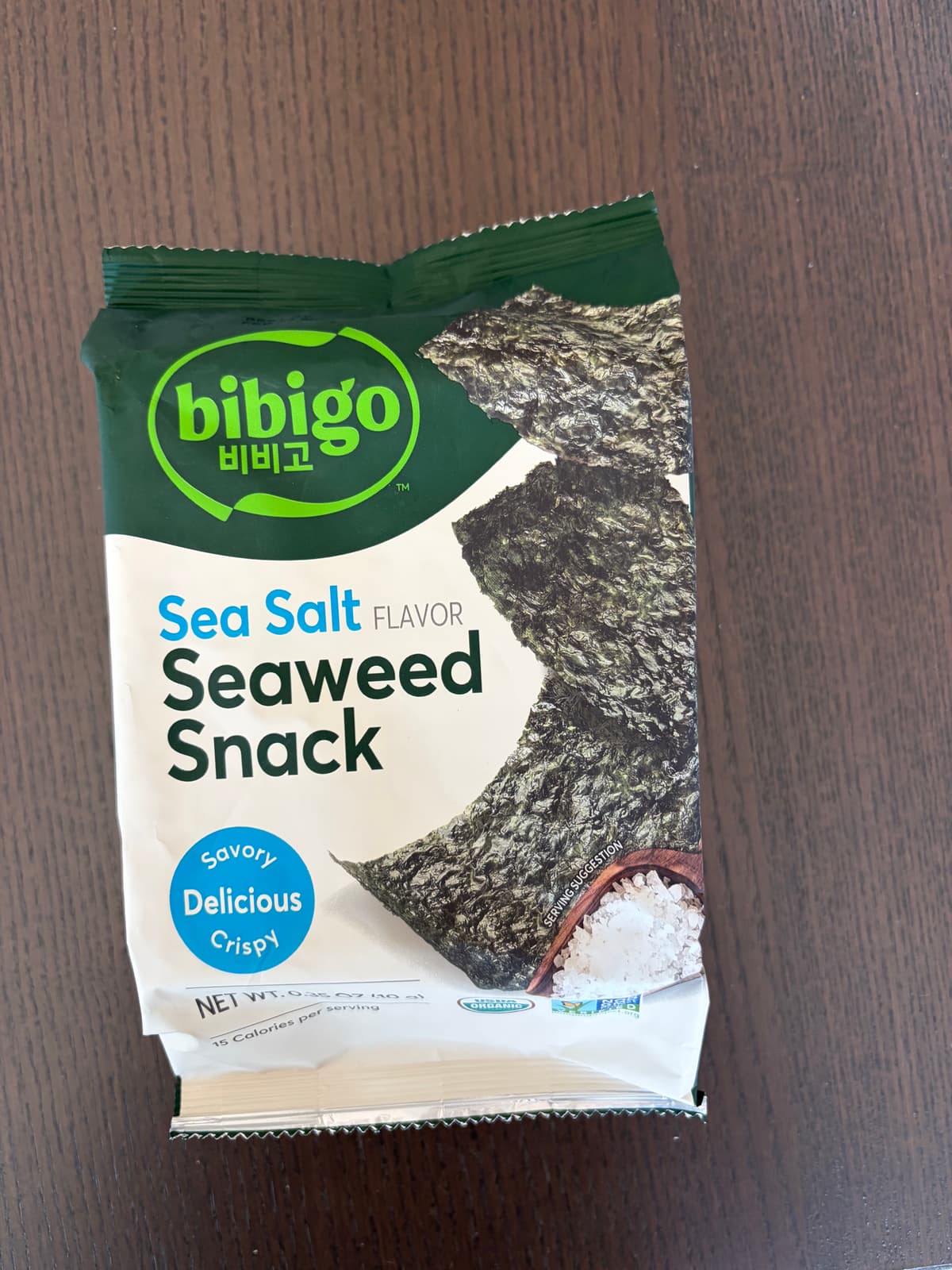
Sea Salt Seaweed Snack
by Bibigo
- Sample lot number
- C1 A10; C1 A02; C1 A10; C1 A02; C1 A10
- Sample expiration date
- Feb 3, 2027
- Requested by
- Hova
Why test
Why test for Heavy Metals Panel?
Tests for lead, arsenic, cadmium, and mercury — metals that build up in the body rather than clearing quickly. Health agencies set intake limits for each, and for lead, U.S. agencies identify no safe level of exposure for children. None of it appears on the label, and levels differ from one product to the next.
Result at a glance
3 contaminants detected of 4 screened
How Canopy shares data
Heavy Metals Panel, compared across the shelf.
A concentration on its own doesn't tell you much — what matters for health is the dose, how much you actually take in. So each bar shows the amount of contaminant in a single serving (the lab's concentration × the labeled serving size, with raw numbers below), measured against daily-intake guidance from several organizations — some of which scales with body weight, so you can enter different weights for yourself or your household. And because we compare products within the same category and subcategory, you can see how similar options stack up and pick a lower-contaminant one.
Enter your body weight
Health limits that scale with body weight recalculate everywhere below. Kept for this session only — not saved to your account.
Snack-size package
The whole package is often eaten in one sitting, so values below default to the full package. Switch to single serving to value every product by its labeled serving instead.


Products are graphed and sorted by their share of the acceptable daily intake (ADI) for a serving of the product. Each regulation is its own dashed guidance line — mouse over a line to see how a serving compares to daily intake limits from different organizations. Data is shown on a log scale for better visibility. Each status column compares that intake against one organization's daily intake limit.
| Metal | Result | Detection limit |
|---|---|---|
| Cadmium (Cd) | 1.14 mg/kg | 0.01 mg/kg |
| Lead (Pb) | 0.07 mg/kg | 0.01 mg/kg |
| Arsenic (As) | 13.2 mg/kg | 0.01 mg/kg |
| Mercury (Hg) | Not detected | 0.01 mg/kg |
Every metal this product was tested for, the exact concentration measured, and the lab's LOD — the lowest amount the method can detect, which each “Not detected” result was measured against. 3 detected; the rest were not detected. Method: MTP-US-5000 (HM_4) + PE-2118 + ICP-MS.
More info · Heavy Metals Panel
How the test is performed
The food sample is broken down with acid, then heated into a plasma (an extremely hot gas) that strips the metals into individual atoms. A detector (ICP-MS) then counts each type of metal atom, identifying exactly how much lead, arsenic, cadmium, or mercury is present — even at parts-per-billion levels.
Good foods to test
- Baby food & infant formula
- Rice & rice-based products
- Chocolate & cocoa products
- Spices (turmeric, cinnamon, oregano)
- Root vegetables (sweet potatoes, carrots)
- Fruit juices (apple, grape)
- Protein powders