Another cinnamon recall. Here's the whole list.
FDA has flagged more than 20 ground cinnamon brands for lead since 2024. What the list shows, where the 2 ppm line comes from, and what it can't tell you about your jar.
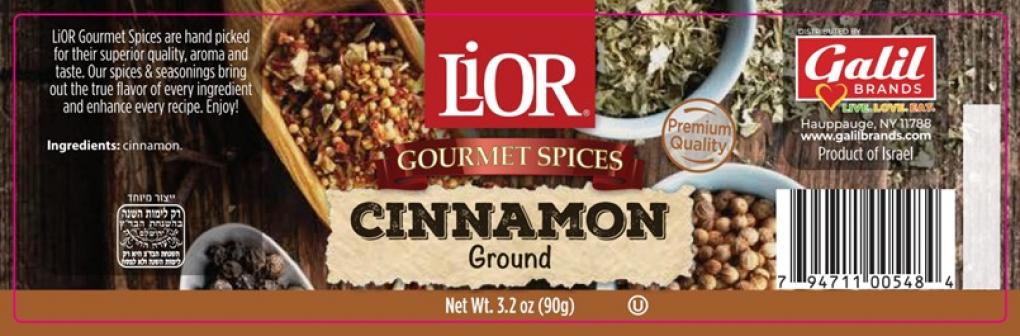
If you saw the Lior cinnamon recall last week and wondered whether the jar in your cabinet is a problem, the answer has three parts: what FDA has flagged, what the numbers mean per serving, and what the list can't tell you about your specific jar.
The recall
On September 24, Galil Importing recalled one lot of Lior Cinnamon Ground Seasoning (lot GAP11304, 90 g containers) after a sample collected by the Maryland Department of Health measured 2.18 ppm lead (FDA recall announcement, Sept 24, 2026; FDA cinnamon alert table). The lot was distributed in New York, New Jersey, Pennsylvania, Texas, Florida, and Illinois between November 2025 and September 2026. No illnesses were reported.
FDA's list and how it got there
In late 2023, FDA traced lead poisoning in children to cinnamon applesauce pouches. The cinnamon in those pouches measured 2,270 to 5,110 ppm lead, consistent with deliberate addition of lead chromate, a yellow pigment (FDA, Investigation of Elevated Lead & Chromium Levels: Cinnamon Applesauce Pouches). That case is in a different category from everything below, but it is why FDA started looking at cinnamon on store shelves.
In March 2024, FDA published results from a targeted survey of ground cinnamon at discount retailers, plus samples from Maryland and Missouri state labs, and flagged six brands. A second alert in July 2024 added more, and FDA has kept adding products as state laboratories and FDA's own retail sampling turned up more (FDA, March 6, 2024 alert; FDA cinnamon alert table, updated through Sept 2026). FDA also tests cinnamon at import and says that sampling has kept some shipments out of U.S. commerce.
As of this writing the table lists more than 20 brands of ground cinnamon, with lead from 2.03 to 10.7 ppm. Each value is one sample of one lot. The full list, with lot codes and retailers, is on FDA's alert page.
One detail is easy to miss. FDA does not order these recalls. Its alert says it "has recommended that the firms voluntarily recall these products," and it updates the table as companies agree. Most have. Several entries, including the highest on the list at 10.7 ppm, still carry no recall announcement, and in one case FDA said it had been unable to reach the company at all (FDA cinnamon alert table; FDA, March 6, 2024 alert). For those products, the alert is FDA's advice to consumers to throw the cinnamon away; nothing has required the product to leave shelves.
Where the line is, and who drew it
FDA has not published a limit for lead in spices. Its alerts say only that the products contained "elevated" lead and that prolonged exposure "may be unsafe." What the table shows is that every flagged product measured above 2 ppm.
That number is not arbitrary. The European Union sets legal maximum levels for lead in spices by plant part: 0.6 ppm for fruit spices, 0.9 for seed spices, 1.0 for bud and flower spices, 1.5 for roots and rhizomes, and 2.0 for bark spices, which includes cinnamon (Regulation (EU) 2023/915, Annex I, section 3.1.26). The American Spice Trade Association publishes industry guidance with the same categories and numbers, and describes them as reflecting "achievability considerations, as well as the varying background concentrations of lead in spices due to unavoidable environmental factors" (ASTA, Guidance Levels for Heavy Metals in Spices, 2024). ASTA's response to Consumer Reports' 2024 cinnamon investigation defended 2 ppm as a level that "balances public health benefits with achievability" and called Consumer Reports' 1 ppm benchmark stricter than what ASTA, FDA, or the EU use (ASTA, Sept 12, 2024).
New York State has used a 1.0 ppm recall action level for lead in spices since 2016. When a 2022 paper proposed lowering it to 0.21 ppm, ASTA calculated that about 46 percent of spice samples would fail and argued that cinnamon data alone would support a limit of 2.4 ppm (Journal of Regulatory Science, 2022).
These limits answer a supply-chain question: what level can cinnamon growers and processors reliably meet, given the lead already in the soil? That is a different question from how much lead a household should take in each day. The next section is about what this means for your household.
What the numbers mean per serving
The labeled serving for spices is 1/4 teaspoon (21 CFR 101.12), which for ground cinnamon is about 0.6 g on most labels. Lead in µg per serving equals concentration in ppm times 0.6.
At 2.18 ppm, the Lior lot delivers about 1.3 µg of lead per quarter teaspoon. At 10.7 ppm, the highest on the list, about 6.4 µg. At 1 ppm, below anything FDA has flagged, about 0.6 µg.
FDA's interim reference levels for lead intake are 2.2 µg per day for children and 8.8 µg per day for women of childbearing age (FDA, Lead in Food and Foodwares). These are daily intake targets, not scaled to body weight. California's Prop 65 maximum allowable dose level for lead is 0.5 µg per day (OEHHA). Against those:
- One quarter teaspoon at 2.18 ppm is about 60 percent of a child's daily reference level, 15 percent of the adult level, and 2.6 times the Prop 65 level.
- One quarter teaspoon at 10.7 ppm is about 2.9 times the child's level, 73 percent of the adult level, and 13 times Prop 65.
- One quarter teaspoon at 1 ppm is 27 percent of the child's level, 7 percent of the adult level, and 1.2 times Prop 65.
The usual case for tolerating lead in spices is that spices are eaten in small amounts. That depends on the diet. Cinnamon in oatmeal every morning, weekly baking, or a dish that uses spices by the tablespoon puts a household well past a quarter teaspoon a day, and exposure scales with the amount eaten. Lead also adds up across foods; cinnamon is one contributor among many, which is the reason FDA's reference levels are set as daily totals.
Two sources put lead in cinnamon. Cinnamon bark picks up lead from its environment, from the soil and dust it grows and dries in and from processing, which is the background ASTA refers to. Lead chromate has also been added to ground cinnamon for color and weight, which is the reason FDA tested chromium alongside lead in its 2024 survey. FDA has not said which source explains the 2 to 11 ppm products on its list.
What the list can't tell you
A brand's absence from the list means either that no one sampled it or that a sample came back below FDA's threshold. You cannot tell which. The list covers only products a state lab or FDA bought and tested; FDA's own alert describes its surveillance as covering a subset of what is imported.
Each entry is one sample of one lot. It does not describe other lots of the same brand.
Consumer Reports tested 36 ground cinnamon products and blends in 2024 and found detectable lead in all of them; 12 exceeded 1 ppm, and the lowest three measured 0.02 to 0.04 ppm (Consumer Reports, Sept 2024). Some lead is typical in cinnamon. How much varies by roughly 100-fold across products on the shelf.
Two questions come up whenever cinnamon and lead are discussed. First, Ceylon versus cassia. The difference between them is real for coumarin, a compound present in cassia at far higher levels than in Ceylon. For lead, independent panels that included both types found Ceylon products ranging from near zero to above 1 ppm, overlapping with cassia (Mamavation, 2024). Cinnamon type does not predict lead. Second, grinding your own sticks. This removes the adulteration pathway, since lead chromate is added to powder. It does not remove environmental lead already on or in the bark.
What this means for your kitchen
Ground cinnamon keeps for years, so check the jar against FDA's list. If cinnamon is a daily ingredient in your house, the amount matters more than for an occasional user, and using less is the one lever fully in your control.
Beyond that, the list can't answer the question most people are asking, which is how much lead is in the cinnamon they already own. The only way to know is to measure it. Testing a single product is expensive for one household, so Canopy lets you request a test on any product and split the cost with friends and family who buy the same one. Request a test.
Ready to pool in? Open tests are waiting for backers right now.
Browse open tests →