Kale chips were recalled for thallium. What we know about it.
Brad's kale chips were recalled after a person with elevated thallium led California health officials to test them. Here is what the record shows and why greens take it up from soil.
Kale chips have a health halo. They are a vegetable, they are crunchy, and many carry an organic label. Many shoppers read organic as free of contaminants, but organic is a standard for how food is grown, and it sets no limits on metals in the finished food (Rodale Institute; 7 CFR 205.670).
Even people making the best decisions they can for their health can run into contaminants. A family in 2022 and an individual in 2026 each ended up with elevated thallium. California health officials investigated the first case in 2022. A recall of a kale chip brand did not come until November 2026, about five and a half months after the state's public warning (CDPH investigation page; CDPH release NR26-021; FDA recall notice).
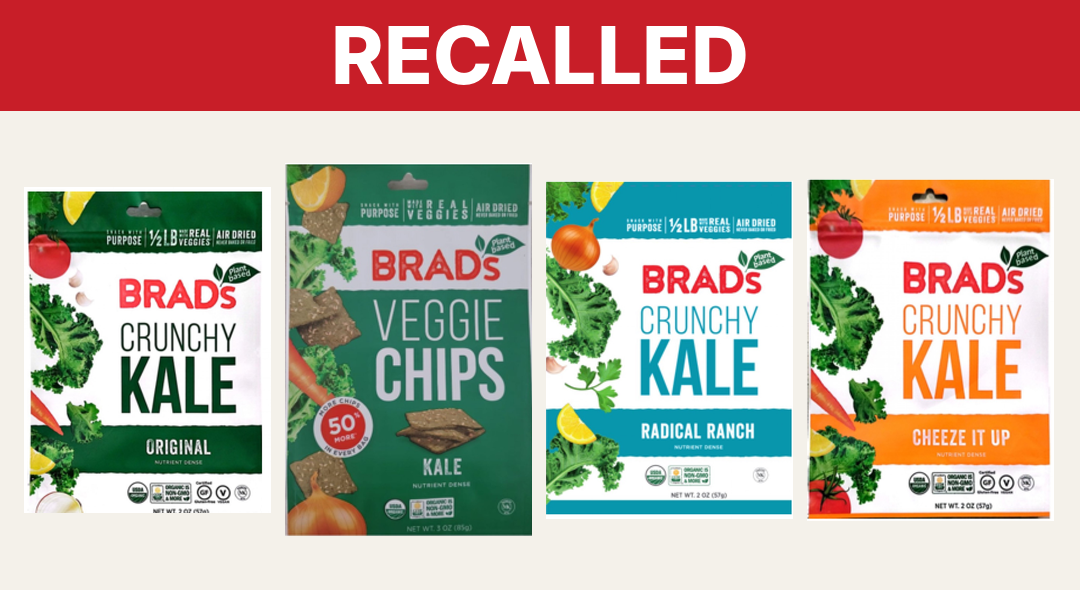
On November 2, a snack company announced a recall of four kale chip products because they contained thallium, a metal with no limit in U.S. food rules. FDA posted the recall on November 3. All four recalled products carry the USDA Organic seal on their bags (bag photos in the FDA recall notice). This post covers what the record shows, how thallium ends up in kale, and what Canopy can test today.
What was recalled
Snack Right Super Foods, doing business as Brad's Raw Chips, recalled four Brad's Plant Based products: Crunchy Kale Original (2 oz), Crunchy Kale Cheeze It Up (2 oz), Crunchy Kale Radical Ranch (2 oz) and Veggie Chips Kale (3 oz). The recall covers 11 lots, about 25,000 bags sold from October to December 2025, with best-by dates from December 21, 2026 to February 17, 2027 (FDA recall notice). The company says its process did not add thallium and that drying removes 85 to 90 percent of the water, which concentrates elements already in the kale. The company is not offering refunds, and the FDA notice says not to return the products to the store.
In May, the California Department of Public Health (CDPH) advised consumers to avoid all Brad's products containing kale, and named eight (CDPH release NR26-021). Four are in the recall (FDA recall notice). The other four are Crunchy Kale Vampire Killer, Crunchy Kale Nacho, Balsamic Salad Snack and Ranch Salad Snack. We could not find an explanation for why all eight products were not recalled.
Two separate cases
In 2022, CDPH investigated a family who had become ill. A dietary survey pointed to a brand of organic kale chips. The mother had months of numbness and tingling in her hands and feet, loose stools, hair loss, fatigue, night sweats and dizziness, and nerve testing found mild sensory neuropathy in both legs. The twins both had loose stools starting in February 2022. One also had abnormal eye movements, bouts of leg pain that limited walking and heavy sweating. The other had arm shaking while feeding and occasional whole-body jerks. Brain imaging and EEGs were normal, and no diagnosis was reached for the twins' neurologic symptoms. The 5-year-old and the father had no unusual symptoms. After the chips were stopped, the mother's nerve testing returned to the normal range by June 2023 and her stomach symptoms resolved by August 2023, though hair thinning remained a concern. Some of the twins' symptoms persisted. CDPH identified the kale chips as the likely source, and FDA describes the family's illness as adverse health effects associated with them (2025 case report; CDPH investigation page; FDA thallium page).
Urine tests showed elevated thallium. The mother measured 5.6 µg/g creatinine in July 2022, about 12 times the CDC's 95th percentile for adults (0.456). Twins aged 2 measured 6.8 and 9.7, about 9 and 12 times the 95th percentile for children 3 to 5 (0.793). The father, who did not eat the chips, was in the normal range. The family ate an organic brand of kale chips intermittently, with peaks of one to three 28 g servings a day for several days. Two samples of those chips measured 1.98 and 2.15 mg/kg, and the family's levels fell after they stopped (2025 case report; CDPH investigation page). CDPH did not name the brand.
The Brad's investigation began in January 2026 with an inquiry about one person with elevated thallium (CDPH release NR26-021). The sources we found do not link the two brands.
The timeline
2022: CDPH finds the family's chips elevated and turns the investigation over to FDA (CDPH gives no date for the handoff; CDPH investigation page).
March 2024: Thallium appears on FDA's list of chemicals under review. FDA begins testing thallium in all Total Diet Study foods (FDA list of chemicals under review; FDA thallium page).
January 2026: CDPH begins investigating Brad's kale products and buys samples at Sacramento-area stores (CDPH release NR26-021).
May 19, 2026: CDPH warns consumers. Its release says the manufacturer was asked to recall and has refused (CDPH release NR26-021).
August 2026: FDA adds Brad's kale products to its import alert for toxic elements, flagging them for thallium and two of them also for cadmium. The alert allows shipments to be detained at the border without being examined (FDA Import Alert 99-42).
November 2 to 3, 2026: The recall, after FDA advised the firm of thallium in tested products (FDA recall notice).
That is about ten months from the January inquiry to the recall, and about five and a half from CDPH's public warning.
What guidance exists for thallium
The family became ill, and CDPH and FDA both tie the illness to the chips. Even so, FDA has set no limit for thallium in food. CDPH says the toxicology data needed to set a standard are lacking (CDPH investigation page). Anyone trying to judge a thallium result in food has no food-specific guidance to compare it with.
The important distinction is between a limit for a specific food and a toxicological reference value. EPA's drinking water program uses an oral reference dose of 0.00007 mg/kg of body weight per day (0.07 µg/kg/day), from a 1992 criteria document and based on a 90-day rat study (EPA Six-Year Review 4). EPA's 2009 IRIS review did not derive a new one because of limitations in the studies (EPA IRIS). EPA's 2024 drinking water review kept the 1992 value as the basis for its assessment (EPA Six-Year Review 4). That value is not an FDA limit for kale chips, and how well it applies to thallium in food is uncertain. The only numeric limit FDA cites is 2 ppb for bottled water, the same as EPA's drinking water limit (FDA thallium page; Shipkowski et al.).
At 2 mg/kg, the level in the 2022 chips (2025 case report), a 1 oz (28 g) serving holds about 56 µg of thallium (our arithmetic). EPA's reference dose works out to about 4.8 µg a day for a 150 lb (68 kg) adult (our arithmetic), so one serving would be roughly 12 times that. Two liters of water at the 2 ppb limit holds 4 µg. The sources we found give no child-specific figure. No concentration has been published for the Brad's products, so these amounts describe the 2022 chips.
How thallium gets into food
Thallium occurs naturally in rock and soil, at roughly 0.1 to 1 mg/kg in soil (Shipkowski et al.), and kale can concentrate it to levels above those in the soil it grows in (Pavlíčková et al.). In 2023, FDA scientists reported a convenience sample of 90 foods containing leafy green ingredients, with an emphasis on kale and other brassicas. Thallium ranged from below detection to 2,410 ppb, with a median of 7.1 ppb, with the highest levels in kale-containing products and a higher mean for kale chips than for the other products tested (FDA ACS poster). New Zealand's 2024 Total Diet Study found up to 0.29 mg/kg in fresh kale, the highest of any food it measured (2025 case report). Dehydration removes water while retaining much of the thallium already present, increasing its concentration by weight. The precise concentration factor depends on the initial moisture content, final moisture content, and processing conditions. FDA says low-level detections do not necessarily mean a food should be avoided (FDA thallium page).
Human activity adds to the natural background. ATSDR names coal burning, smelting and cement production as the primary sources of release, and says people are most likely to be exposed through fruits and vegetables grown in soil that contains thallium, more so when the soil is contaminated (ATSDR ToxFAQs). Near a cement plant in Germany, isotope measurements tied elevated topsoil thallium to the plant's emissions (Kersten et al.). Deliberate uses are small, and thallium was banned from rodent poisons in 1972 (USGS Mineral Commodity Summaries; ATSDR ToxFAQs). Large soil surveys find that geology controls most of the variation, with contamination mattering mainly near long-running heavy industry (Thallium datasets commentary).
Thallium in a leaf is the same element whether it came from bedrock or a smokestack, and the body responds to how much is eaten. We could not find where the Brad's kale was grown or anything about the soil it was grown in, so we cannot say which source applies to the recalled chips.
Canopy's panel covers lead, arsenic, mercury and cadmium. Leafy greens generally pick up more metals from the soil than fruiting plants, and how much depends on the metal. Organic rules ban sewage sludge and arsenic and lead salts and tell farmers not to add heavy metals through manure or compost, but they set no metal limits in the soil itself (Rodale Institute; ConsumerLab). Certifiers sample at least 5 percent of the operations they certify each year, including soil and plant tissue, but metal testing is not required for the organic label, and we found no mention of thallium (7 CFR 205.670; ConsumerLab). The chips in the 2022 case were organic (CDPH investigation page).
What we don't know
Why four of the eight products were recalled. Whether the kale chips in the 2022 case and the Brad's chips share a supplier or growing region. What thallium levels the Brad's products contain. How much thallium ordinary retail kale carries. What intake is acceptable: CDPH says regulators lack the toxicology data to set a standard (CDPH investigation page), and NTP is running studies (FDA thallium page). Its 2023 short-term studies in rats and mice found hair loss and lower body weight at drinking water levels of 12.5 and 25 mg/L, and thallium passed from mother to offspring (Shipkowski et al.).
Where Canopy fits
Thallium isn't on our panel today and isn't routine for our labs. We're looking into adding it, with no timeline to share yet. FDA ran its analysis by ICP-MS (FDA ACS poster), the technique our qualified laboratory partner uses for our four-metal panel.
Cadmium also comes from the soil, and leafy greens take it up. The two Brad's products FDA flagged for cadmium in its August import alert were Veggie Chips Kale and Crunchy Kale Cheeze It Up (FDA Import Alert 99-42). The alert gives no concentrations. Cadmium is on our panel, so we can test for it now. A test request is open for Kale Bros The Classic Kale Chips, a dried-greens product, and it still needs funding. If it is funded, the result will be compared with Prop 65, EFSA and FDA guidance.
If there's a kale chip or greens powder you buy, you can request a test on any product. Send the request to everyone you know who buys the same one. The test runs once enough of you have chipped in.
What this means for your choices
CDPH advised avoiding all Brad's products that contain kale (CDPH release NR26-021). If you have the recalled products, the FDA notice lists the lot codes and says to stop eating them and discard them. FDA also says anyone who thinks they had adverse effects should contact a health care provider.
The levels in the Brad's products have not been published, so we cannot say how high they are. Thallium and cadmium both come from the soil that greens grow in, and eating a mix of greens and snacks spreads exposure across many foods instead of one.
Sources
- FDA recall notice, Snack Right Super Foods, Inc. dba Brad's Raw Chips, with lot numbers (FDA posted Nov 3, 2026)
- CDPH release NR26-021, "CDPH Warns Consumers Not to Eat Brad's Plant Based Products" (May 19, 2026)
- CDPH investigation page, "Investigation Spotlight: Thallium and Kale Chips"
- FDA thallium page
- FDA list of chemicals under review, "List of Select Chemicals in the Food Supply Under FDA Review"
- FDA ACS poster, "Determination of thallium in foods containing brassica" (2023)
- 2025 case report, "Thallium Exposure Secondary to Commercial Kale Chip Consumption," International Journal of Environmental Research and Public Health (2025)
- Shipkowski et al., "Short-term toxicity studies of thallium (I) sulfate administered in drinking water to Sprague Dawley rats and B6C3F1/N mice," Toxicology Reports (2023)
- EPA IRIS, Toxicological Review of Thallium and Compounds (2009)
- Pavlíčková et al., "Uptake of thallium from artificially contaminated soils by kale," Plant, Soil and Environment (2006)
- ATSDR ToxFAQs, "ToxFAQs for Thallium" (reviewed Nov 2024)
- USGS Mineral Commodity Summaries, "Thallium" (February 2026)
- Kersten et al., "Tracing anthropogenic thallium in soil using stable isotope compositions"
- Thallium datasets commentary, "Publicly available datasets on thallium (Tl) in the environment," Environmental Monitoring and Assessment (2017)
- 7 CFR 205.670, National Organic Program residue testing rule
- Rodale Institute, "Heavy Metals" (on 7 CFR 205.203(c) and OMRI input thresholds)
- ConsumerLab, "USDA Organic seal and heavy metals"
- EPA Six-Year Review 4, "Results of the Health Effects Assessment for the Fourth Six-Year Review of Existing Chemical and Radionuclide National Primary Drinking Water Standards" (February 2024), thallium section 6.1.33
- FDA Import Alert 99-42, detention without physical examination of foods due to toxic elements (Brad's entries dated August 2026)
Ready to pool in? Open tests are waiting for backers right now.
Browse open tests →