The post says 36 pieces a year. Can you trust that number?
Viral Instagram posts say your kid can only eat 36 Sour Patch Kids a year before getting too much arsenic; the data behind them can't be checked and is far above what FDA and an independent retest found. Four Halloween candies are open for testing on Canopy now, with detection limits, benchmarks, and math shown, so you can get a number you can trust before October 31.
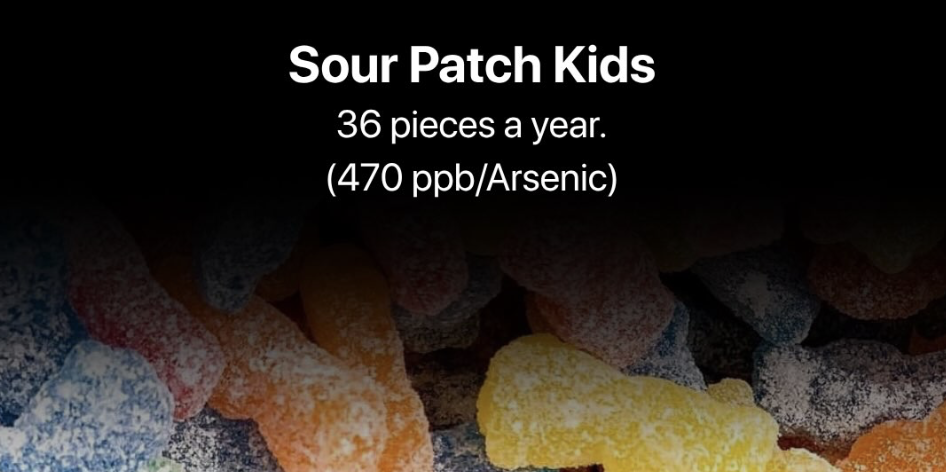
If you've been on Instagram this year, you've probably seen the post: a photo of Sour Patch Kids, and above it, "36 pieces a year." Jolly Ranchers, 6 pieces. Twizzlers, 4. Nerds, 96. The caption says this is how much candy your child can eat before they've had too much arsenic. The data behind it was published in January, and the posts have been circulating ever since, picking up again now that Halloween is a few weeks out. They're one of a genre: a product photo, a scary number, a source that sounds official, and no way to see where the number came from. If you have a trick-or-treater at home, they're hard to scroll past.
You don't have to take the post's word for it, and you don't have to dismiss it either. There's a third option: get the product tested by a laboratory that reports its detection limit, compare the result to benchmarks you can look up, and see the math. First, what the Florida report does and doesn't show. Then, the four candies you can get tested right now, and how to add any other candy you care about.
Where heavy metals plausibly come from in candy
Whether a contaminant is likely to be in a food depends on what the food is made of and how it was made. Here's what that means for the three kinds of candy that fill most Halloween bags.
Chocolate. Cacao takes up cadmium from soil, and lead tends to arrive after harvest, from dust and soil contact during drying and handling (Consumer Reports, Dec 2022). Consumer Reports' 2022 testing of dark chocolate bars found lead or cadmium above California's Prop 65 daily limits in a majority of the bars it tested, with milk chocolate generally lower because it contains less cacao. Those two metals are the reason to test a chocolate bar. Arsenic is not the metal chocolate is known for.
Fruit snacks. Gummies made with fruit puree and juice concentrate inherit whatever was in the fruit. Apple and grape juice concentrates are documented carriers of arsenic and lead, which is why FDA set action levels for both in juice (FDA, 2023) and why Consumer Reports found measurable arsenic, lead, or cadmium in most of the juices it tested in 2019. A fruit snack that leads with "made with real fruit" is, from a testing standpoint, a concentrated juice product. That said, the one public dataset that has looked, FDA's Total Diet Study, found no arsenic, cadmium, lead, or mercury in fruit snack candies at low-ppb detection limits (more on that below). Plausible pathway, no detection so far: a good reason to test a specific brand.
Sugar candy. Hard candy, sour gummies, and pressed-sugar candy are mostly sugar, corn syrup, gelatin, acids, and colors. There's no ingredient in that list with a known arsenic pathway, which is part of why the Florida table drew questions from toxicologists. That's a reason to test, not a reason to dismiss the result.
Where the Instagram numbers come from
The posts trace back to Healthy Florida First, a Florida Department of Health initiative that published candy testing results in January 2026. The state says it tested 46 candy products from 10 companies and detected arsenic in 28 of them (Florida DOH, Jan 26, 2026). For each product with a detection, the site lists a total arsenic concentration, from 180 to 570 parts per billion, and an approximate number of pieces per year it considers "safe" for a child and an adult (exposingfoodtoxins.com/candy).
That table is the whole public record. There is no detection limit, no lot number, and no statement of how many units of each product were tested. Products without a detection show a dash. And the candy testing reports arsenic only: no lead, cadmium, or mercury results are listed for any product.
Show your work
A number you can act on is one you can check. That takes three things: how the measurement was made, what it was compared against, and the arithmetic in between. The Florida table gives none of them.
The measurement. The Department of Health has said samples were analyzed using EPA Method 6010D (statement to the Daytona Beach News-Journal, reported in Food Safety Magazine, Feb 9, 2026), a method written for soil and water, and it did not publish a detection limit. Every detected value in the table sits between 180 and 570 ppb, a narrow band for 28 different products. For comparison, the heavy metals method used by the qualified laboratories in Canopy's network reports arsenic in food down to about 10 ppb, and FDA's own food surveillance reports it down to 1 to 7 ppb depending on sample size (FDA Total Diet Study, FY2018-2020 Elements Report, Appendix B). A detection limit tells you what a non-detect means. Without one, "risk not identified" could mean anything from "none found at 1 ppb" to "none found at 200 ppb."
The benchmark. The state says the "pieces per year" figures come from ATSDR minimal risk levels, screening values built for hazardous waste site assessments (ATSDR, 2007). The ATSDR value for inorganic arsenic works out to about 4.5 µg/day for a 15 kg child. Work backward from Florida's own pieces, piece weights, and concentrations and the allowances imply 0.02 to 0.08 µg/day, roughly 50 to 200 times lower, and a heavier child assumption only widens the gap. FDA, for its part, has no daily-intake number for inorganic arsenic at all, only action levels for apple juice (10 ppb, 2023) and infant rice cereal (100 ppb, 2020). So the per-year figures don't match the benchmark the state cited, and there's no FDA figure they could match.
The arithmetic. Pieces per year should fall as concentration rises. They don't. Florida lists Jolly Rancher Sour Apple at 540 ppb and Jolly Rancher Strawberry at 320 ppb, same piece weight, and gives both 6 pieces a year. Tootsie Fruit Chew Lime at 570 ppb and Tootsie Roll Vanilla at 370 ppb, same weight, both get 8. Multiply pieces by the table's own gram-per-piece figures and the child allowance lands between 35 and 60 grams of candy a year for 24 of the 28 products, whether they tested at 180 ppb or 570 ppb. The count on the Instagram post isn't a function of what that candy measured.
None of this means Florida's numbers are wrong. It means a parent can't check them, and toxicologists who tried couldn't either (Food Safety Magazine, Feb 9, 2026).
Two other data points
Two other sources have looked at the same question, and neither lines up with the Florida table.
FDA's Total Diet Study, an ongoing survey of retail foods, tested candy over 2018 to 2020 using ICP-MS with an arsenic reporting limit of 3 ppb, and each of its samples is a composite of product bought in three different cities (FDA TDS FY2018-2020 Elements Report and Supplement, July 2022). Hard candy: arsenic detected in all three samples, at 11 to 15 ppb, with cadmium, lead, and mercury not detected. Fruit snack candies: arsenic, cadmium, lead, and mercury all not detected in all three samples. Plain milk chocolate bar: arsenic at or below 3.3 ppb, cadmium in every sample at 15 to 26 ppb, and lead in every sample at 7.4 to 8.3 ppb, under FDA's 100 ppb action level for lead in candy. Chocolate nougat bar with nuts: arsenic no higher than 7.8 ppb, cadmium in every sample at 13 to 17 ppb, lead and mercury not detected; Florida lists Snickers, the same kind of bar, at 350 ppb arsenic. So FDA does find arsenic in hard candy, at about 13 ppb, roughly 15 to 45 times below Florida's band. And the metals FDA finds in milk chocolate are the two Florida's candy report doesn't cover.
An independent retest of one product on Florida's list, Twizzlers Strawberry, came back around 30-fold lower than the state's figure (Lead Safe Mama, Aug 2026). One retest is not a refutation, but when two tests disagree by that much on the same product, the question is the method, and the way to settle it is more data: more units, more lots, tested by a method whose detection limit is on the report.
What we're testing
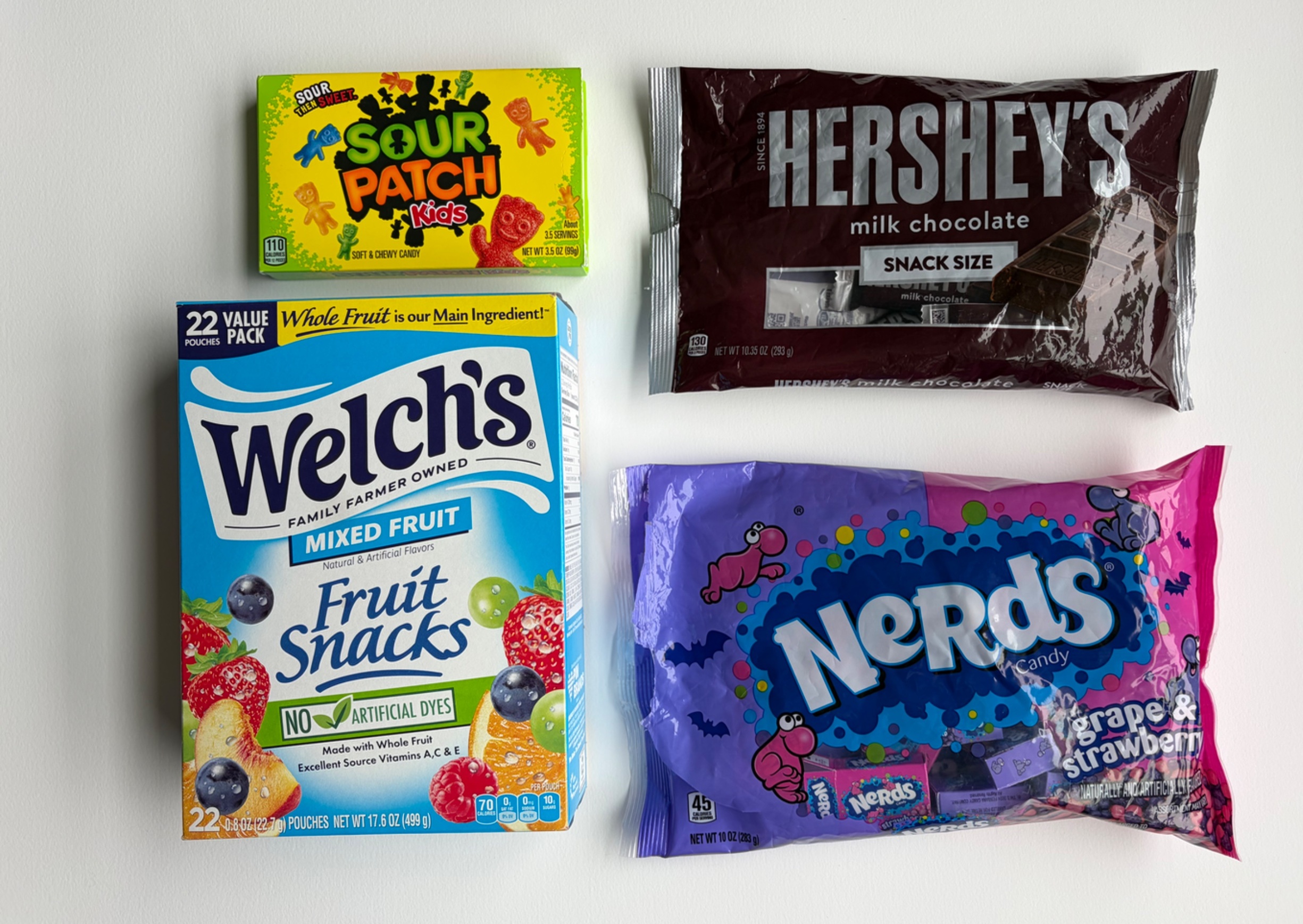
Four candy test requests are live on Canopy right now, each for a full heavy metals panel (lead, arsenic, cadmium, and mercury, by ICP-MS at a qualified laboratory):
- Nerds Halloween Strawberry Mini Boxes. On Florida's list at 450 ppb arsenic, and in the Instagram posts at 96 pieces a year.
- Sour Patch Kids. On Florida's list at 470 ppb. The one in the Instagram photo, at 36 pieces a year.
- Hershey's Chocolate Bar, Snack Size. Florida reported no arsenic detected in Hershey's Milk Chocolate, and reported nothing on lead or cadmium, the two metals chocolate is known for.
- Welch's Fruit Snacks, Mixed Fruit. Not on Florida's list. Made with fruit purees and juice concentrates.
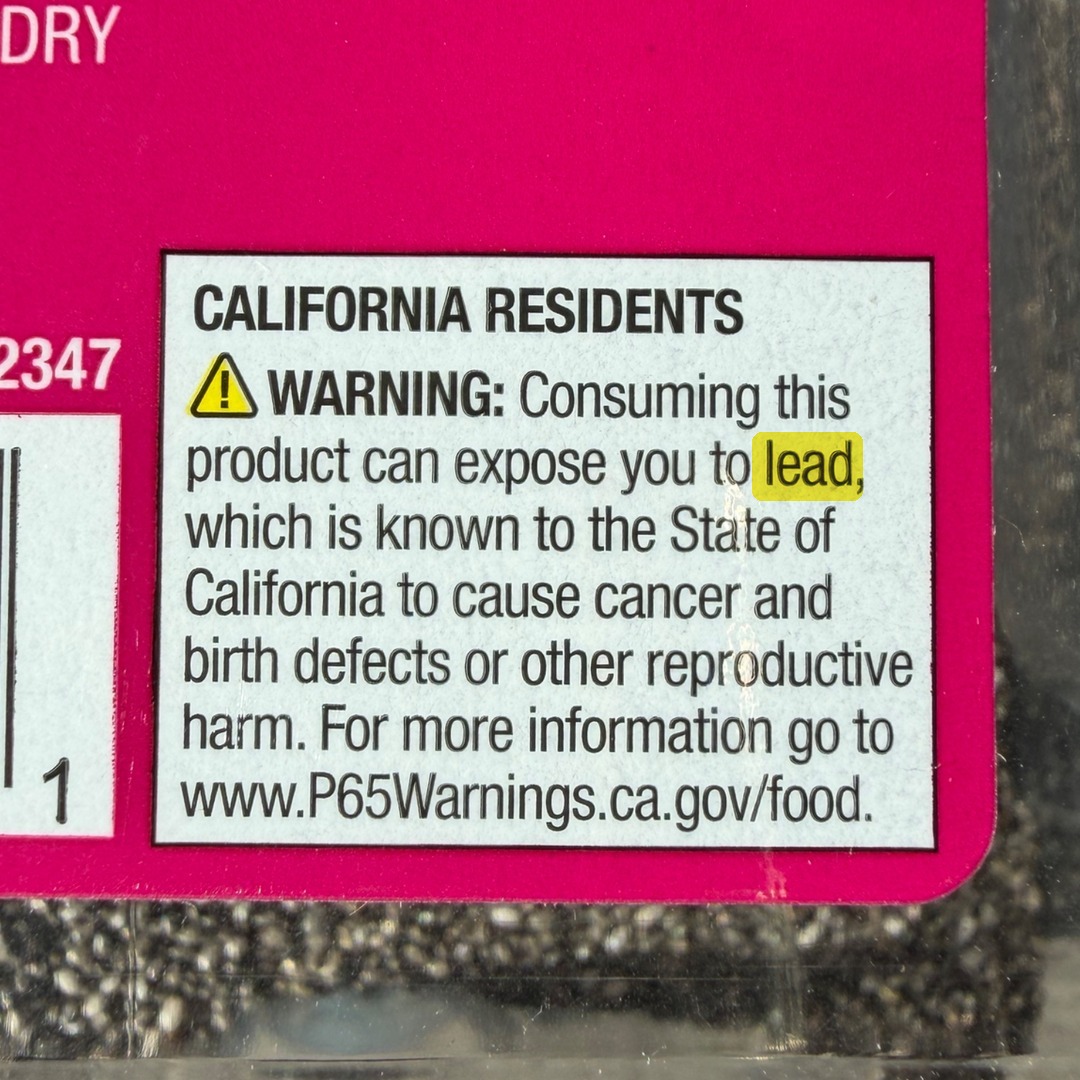
We chose a four-metal panel rather than arsenic alone because that's the standard panel for heavy metals testing in food, and it gives a more complete picture of exposure. Arsenic is the metal in the headline, but lead and cadmium are the ones chocolate is known for, and fruit snacks can have all three.
When results come back, each will be a single test of a single unit bought at a specific store on a specific date, reported with its detection limit and lot number, and placed against the reference lines Canopy uses for heavy metals (California Prop 65, FDA's Interim Reference Level for lead, and EFSA's health-based intakes), with the serving size, body weight, and math shown on the page so you can rerun it yourself. It won't tell you whether every bag on every shelf looks the same. It will tell you whether the number on Instagram holds up for the bag we bought, measured by a method that can be checked.
The bowl fills up on October 31
Each of these tests needs about $286 to run, and each request closes in roughly 30 days, around October 8. Funded by then, results will be back before Halloween candy comes home.
If one of these is the candy in your house, this is the direct route to an answer: back the test, share it with the other parents who buy the same thing, and split the cost. And if the candy you're wondering about isn't on the list, propose it and rally the other people who buy it to get the result.
The scary posts will keep coming around every October. A result you can check, from a lab you can trust, with the work shown, is what lets you keep scrolling.
Sources cited: Florida Department of Health press release (Jan 26, 2026); exposingfoodtoxins.com/candy; Food Safety Magazine, "Scientists Say Missing Data in Florida Reports on Metals in Candy, Infant Formula Create Confusion" (Feb 9, 2026); FDA Total Diet Study, FY2018-2020 Elements Report and Supplement (July 2022); Lead Safe Mama, Twizzlers Strawberry retest (Aug 2026); FDA, Action Levels for Lead and Inorganic Arsenic in Juice (2023); Consumer Reports, dark chocolate (Dec 2022) and fruit juice (Jan 2019) testing.
Ready to pool in? Open tests are waiting for backers right now.
Browse open tests →