No Safe Level: Why Our EFSA Line for Lead Just Moved
We lowered the EFSA reference line for lead on our charts by a factor of ten, following EFSA’s own guidance. No agency has found a safe level of lead, so each publishes a number for a different purpose under a different name. The post walks through what FDA, EFSA and Prop 65 each measure and how to read a result against a daily budget.
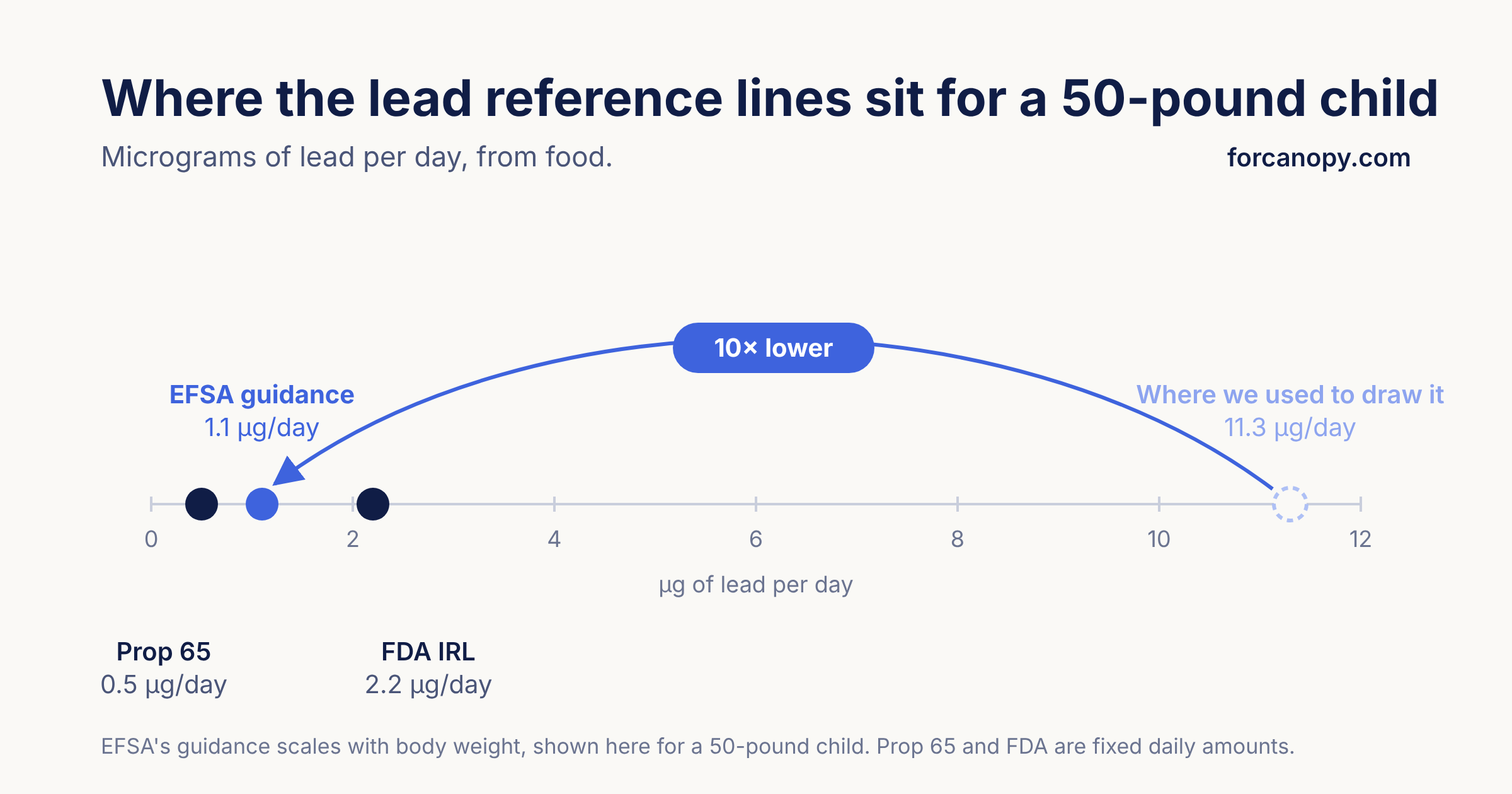
We've lowered the EFSA reference line for lead on every Canopy result page by a factor of ten, from 0.5 to 0.05 micrograms per kilogram of body weight per day. That's about 3.5 micrograms a day for a 70 kg adult and 1.1 micrograms a day for a 50-pound child. The lab numbers haven't changed. The line we compare them against has, in accordance with EFSA's own guidance, and some products that passed the old EFSA line for lead now exceed the new one.
The short version is that we were previously plotting EFSA's reference point, which is the level EFSA ties to a 1-point IQ loss in children. EFSA divides that number by 10 and says that level should be sufficient to ensure that there are no appreciable risks to IQ. That's the number we now show on our plots.
This post walks through the vocabulary of lead guidance, why the numbers from different agencies look so different, and what the new line means when you read a result.
"No safe level" is the official position
The FDA, the CDC, the European Food Safety Authority, and the World Health Organization all say the same thing: no level of lead exposure has been identified that is safe for children. This isn't caution for its own sake. The largest pooled analysis of children's blood lead and IQ, drawn from seven cohort studies on three continents, found that the IQ loss continued all the way down to the lowest blood lead levels measured, with no floor, and that the loss per unit of lead was steepest at the lowest exposures. Every agency that has looked at the data since has reached the same conclusion: there is no threshold to set a limit under.
But lead is everywhere, so agencies need a number
Lead is in soil, partly from the earth's crust and mostly from a century of leaded gasoline, paint, mining, and smelting. Plants take it up from soil and dust settles on their leaves. It's in water that passes through old pipes. It ends up in bread, potatoes, leafy vegetables, root vegetables, tea, chocolate, spices, and seaweed, at levels that vary with where the crop was grown and how it was processed. The average American child gets most of their dietary lead from the foods they eat most, grains, dairy and fruit, in small amounts that add up. A few foods carry much more per serving, including root vegetables like sweet potatoes and carrots, fruit juice, chocolate, and seaweed, and those are the ones where a different choice makes a measurable difference.
You cannot regulate against zero when zero doesn't exist. A limit of zero would ban bread. So every agency that deals with lead in food has to pick a number above zero and defend it, and the honest way to do that is to say exactly what the number is for. The FDA's number is for setting action levels for lead in specific foods. EFSA's is for estimating how far current European diets sit from the dose that causes harm. California's is for deciding when a product needs a warning label. Three agencies, three jobs, three numbers.
The vocabulary is built to avoid the word "safe"
For most pesticides, there's a clean term: the Acceptable Daily Intake, or ADI. It's the amount you can eat every day for a lifetime without appreciable risk, and agencies say so plainly. Lead has no ADI, because an ADI implies a threshold and lead doesn't have one. So each agency has invented a term for "the number we use" that carefully avoids implying safety.
| Term | Agency | What it is |
|---|---|---|
| Interim Reference Level (IRL) | FDA | The daily intake from food that would produce a blood lead level ten times below the CDC's reference value for children. "Interim" because FDA expects to lower it as CDC's value falls. |
| BMDL01 with a Margin of Exposure (MOE) of 10 | EFSA | The BMDL01 is the lower confidence bound on the dose associated with a 1-point drop in children's IQ, a reference point rather than a limit. EFSA says exposure should be at least 10 times below it (an MOE of 10 or more) for no appreciable risk; between 1 and 10 the risk is low but can't be dismissed; below 1 an effect can't be excluded. Our line is the BMDL01 divided by 10. |
| Maximum Allowable Dose Level (MADL) | California OEHHA (Prop 65) | The dose at which a product must carry a reproductive-harm warning. Developed in 1989 from a no-observable-effect level in adults and a 1,000x safety factor, and never revised. |
None of these is a limit on how much lead you can eat. Each agency has gone to real lengths to avoid saying "safe," and the result is a set of terms that sound alike and mean different things. A consumer reading "reference level" next to "reference point" has no way to tell that one already has a safety margin built in and the other is the dose where harm starts. The care that produced these names is exactly what makes them hard to use.
Nobody meets this line, and that's expected
The line we now plot, 0.05 micrograms per kilogram of body weight per day, is a negligible-risk bar, and most children don't meet it. FDA's Total Diet Study puts the average American child aged 1 to 6 at 1.5 micrograms a day, which for a 15 kg child is 0.10 micrograms per kilogram, twice the EFSA line. Infants on formula average 1.3 micrograms a day, or about 0.13 per kilogram. These are ordinary diets, not outliers.
That's by design. EFSA built its margin-of-exposure approach to measure how far a population sits from harm, and an MOE of 10 is where it says the risk becomes negligible. Nobody claimed diets were there. When EFSA compared the reference point with European exposure in 2010, it concluded effects on some children "cannot be excluded," and that finding is what has driven the EU to keep lowering its maximum levels for lead in food under the principle of "as low as reasonably achievable." The line marks the destination, and regulation is the slow process of moving toward it.
What this means when you read a Canopy result
A product exceeding the EFSA line for lead is going to be common on our site now, especially when you scale to a child's body weight. That's expected. The questions that matter are how far over it is, how it compares with similar products tested the same way, and how it fits into the rest of the child's diet.
That last one is easy to lose sight of. Every line on our charts is a daily budget for the whole diet, and we're comparing one serving of one product against it. A single serving rarely reaches 2.2 micrograms on its own. What gets a child to the IRL is the sum: the morning cereal, the sweet potato at lunch, the juice, the crackers, the chocolate, each contributing a fraction. So a product that uses 20% of the daily budget in one serving isn't dangerous by itself, but it's taking a big bite out of a budget that the rest of the day will also draw on. That's the way to read the percentages on our charts: not as a verdict on the product, but as its share of a daily total that's easy to exceed without noticing.
But the lines are also more reachable than "no safe level" makes them sound. FDA's own Total Diet Study shows the IRL is a bar most children already clear. In the most recent data (2018–2020), mean lead intake was 1.3 micrograms a day for formula-fed infants and 1.5 micrograms a day for children aged 1 to 6, both under the 2.2 microgram IRL. Even at the 90th percentile, intake was 2.4 micrograms a day, only slightly above it. FDA sets its action levels for individual foods so that a child at the 90th percentile of consumption stays under the IRL, and it sets each action level where about 90% of products already on the market comply. The IRL is a reachable target rather than an aspiration.
So a product that clears the FDA line is doing something most of its category already does. One that misses by a wide margin is an outlier, and in nearly every category we've tested there's a product that sits well below the others. That gap is the useful information. The lines tell you how to read it; the comparison across the shelf tells you what to do with it.
How each agency gets to its number
For readers who want the mechanics, here is how the three lines on our lead charts are built.
California Prop 65 (0.5 micrograms a day). In 1989, California started from a no-observable-effect level for reproductive harm in adults and divided it by 1,000, which is the statutory safety factor for Prop 65 reproductive toxicants. It hasn't been revised since. It's a fixed daily amount, the same for a toddler and an adult, and crossing it triggers a warning label rather than a finding that a food is unsafe.
FDA Interim Reference Level (2.2 micrograms a day for children, 8.8 for women of childbearing age). FDA started from the CDC's blood lead reference value of 3.5 micrograms per deciliter, divided by ten to get a target blood level, then used a model of how dietary lead translates into blood lead to work backward to a daily intake. It's also a fixed amount, so per kilogram it gets more protective as a child gets bigger. FDA lowered it from 3 to 2.2 in 2022 when CDC lowered its reference value, and expects to lower it again.
EFSA (0.05 micrograms per kilogram per day on our charts). EFSA started from the pooled IQ data, found the blood lead level associated with a 1-point IQ loss, took the lower confidence bound (12 micrograms per liter), and converted it to a dietary intake using the EPA's biokinetic model for children: 0.5 micrograms per kilogram per day. That's the BMDL01. Note that the reference point is really a blood lead level, which reflects lead from every source, including dust, soil, water and air; the dietary number is what food alone would have to deliver to reach it. EFSA then said exposure should be at least ten times below it for the risk to be negligible, and one reason that margin isn't excessive is that food is never the only source. Our line is the BMDL01 divided by ten. Because it's per kilogram, it scales with the body weight you enter.
| Reference line | 70 kg adult | 50 lb (22.7 kg) child | 22 lb (10 kg) toddler |
|---|---|---|---|
| Prop 65 MADL | 0.5 µg/day | 0.5 µg/day | 0.5 µg/day |
| EFSA BMDL01 ÷ 10 | 3.5 µg/day | 1.1 µg/day | 0.5 µg/day |
| FDA IRL | 8.8 µg/day (women) | 2.2 µg/day | 2.2 µg/day |
For a child the three lines land within about a factor of four of each other. That's reassuring, since the FDA and EFSA numbers both trace back to the same pooled analysis of children's IQ, and Prop 65 is simply a bigger safety factor on a similar starting point. The spread you see is each agency's margin and its intended use, not disagreement about the science.
One difference between the lines matters more the younger the child. The FDA IRL is a fixed 2.2 micrograms a day for every child; FDA applies the same number to children aged 0 to 6 and to older children alike. The EFSA line scales with body weight, so it tightens as the child gets smaller. For a 50-pound child the EFSA line is half the FDA line; for a 10 kg toddler it's less than a quarter, and it meets the Prop 65 line. That makes the EFSA column on our charts the strictest of the three for the youngest children, which is the group every agency agrees is most sensitive to lead. When you enter a small body weight on a result page, expect the EFSA column to flip to "exceeds" well before the FDA column does.
What we got wrong
Until this week, our EFSA line for lead was the BMDL01 itself: 0.5 micrograms per kilogram per day, or 35 micrograms a day for a 70 kg adult. That's the dose EFSA ties to a measurable effect, and it sits ten times above the level EFSA says is needed before risk can be called negligible. A product could pass our EFSA line while delivering, per serving, the exact intake EFSA uses as its marker for harm. That isn't what a pass should mean, and it made our EFSA column look far more lenient than the FDA and Prop 65 columns beside it, which carry their safety margins built in.
It was an easy mistake to make, and we suspect we're not the only ones who've made it. EFSA publishes 0.5 as its headline number. The margin of exposure that goes with it is a sentence in section 9 of a 151-page opinion. "Reference point" and "reference level" read as synonyms unless you already know they aren't.
If you spotted this before we did, we'd like to hear from you. We'd also like to hear about anything else on the site that looks off. The comparison lines are the part of Canopy that turns a lab number into something you can act on, and we strive to make them accurately reflect the health guidance that is out there.
Sources
- EFSA CONTAM Panel, Scientific Opinion on Lead in Food, EFSA Journal 2010;8(4):1570. The BMDL01 derivation is in section 8.6; the margin of exposure of 10 is in section 9.2, page 105.
- EFSA, Lead dietary exposure in the European population, EFSA Journal 2012;10(7):2831.
- EFSA, Scientific report on dietary exposure to lead in the European population, EFSA Journal 2025;23:e9577.
- Flannery et al., Updated interim reference levels for dietary lead to support FDA's Closer to Zero action plan, Regulatory Toxicology and Pharmacology, 2022.
- Hoffman-Pennesi et al., Infants' and young children's dietary exposures to lead and cadmium: FDA Total Diet Study 2018–2020, Food Additives & Contaminants: Part A, 2024.
- FDA, Action Levels for Lead in Processed Food Intended for Babies and Young Children, final guidance, January 2025.
- Lanphear et al., Low-level environmental lead exposure and children's intellectual function: an international pooled analysis, Environmental Health Perspectives 113(7):894–899, 2005.
- UK Committee on Toxicity, 2022 Annual Report, Lead in the Maternal Diet, paragraphs 1.116–1.117, for a plain-language restatement of EFSA's MOE reasoning.
- Commission Regulation (EU) 2021/1317 amending maximum levels of lead in certain foodstuffs.
Ready to pool in? Open tests are waiting for backers right now.
Browse open tests →